
News
From California to the Arctic: An 88-Year-Old Reader Brings Polar History to Life
A story of historic Arctic exploration found new interest thousands of kilometres away, around a table, shared by a group of friends, a map and a good book.
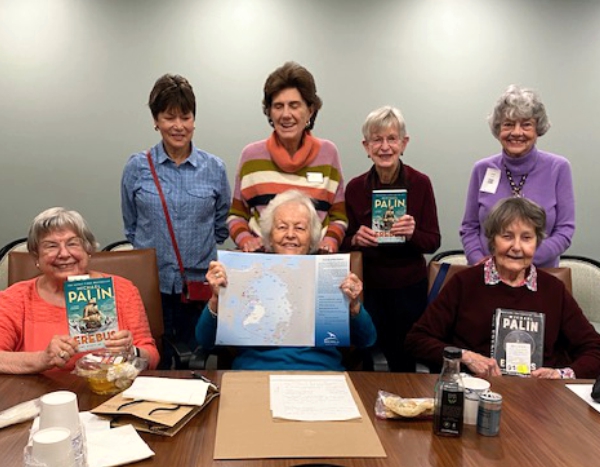
That was the case for Peggy Nute, an 88-year-old woman from California, and the members of her long-running book club. The group, made up of eight women all in their 80s, had chosen Erebus: The Story of a Ship by Michael Palin as their latest read. The book tells the dramatic story of the British naval vessel HMS Erebus, one of two ships that sailed from England in 1845 on Sir John Franklin’s ill-fated expedition to find the Northwest Passage through the Canadian Arctic.
Franklin’s expedition — involving the ships Erebus and Terror and a crew of 129 men — became one of the greatest mysteries in the history of polar exploration. The ships vanished in the Arctic after becoming trapped in ice, and all members of the expedition ultimately perished.
For Peggy and her book club, the story sparked curiosity about the Arctic and the journey the ships had taken nearly two centuries earlier.
A Map Request Across the World
As Peggy prepared for the group’s discussion, scheduled for March 5 at 12:30 p.m., she had an idea. She wanted a map that could help the book club visualize the route taken by the Erebus.
So she reached out to Arctic Portal, asking if it might be possible to create a map of the expedition route across the Arctic.
Her enthusiasm for geography and exploration runs deep.
“I have always been fascinated by travel, geography, National Geographic Magazine and the like,” she explained. Peggy and her husband traveled extensively during their lives, visiting 164 United Nations member countries, sometimes in depth, sometimes briefly, but always with curiosity about the world.
For Peggy, the map was not only about understanding the past. She also hoped the story of the Franklin expedition might spark broader conversations.

The Arctic Portal team created a map showing the Arctic region from above, highlighting the route of the Erebus as it traveled north from England toward the Canadian Arctic Archipelago.
After receiving the map, Peggy had it printed in California so that the group could use it during their discussion.
The idea worked exactly as she had hoped.
Even before the meeting took place, the book had already begun to spark new interests among the group. One member, Peggy noted, had recently read a newspaper article about Antarctica, something she might not have done if the book club had not chosen Erebus.
For Peggy, that was proof that the book club discussion was already doing what she hoped: opening doors to curiosity about the polar regions.
A Story That Still Resonates
Michael Palin’s book follows the remarkable history of HMS Erebus, from its early years as a British naval bomb vessel to its later voyages of exploration in both Antarctica and the Arctic.
The ship’s most famous voyage was its final one in 1845, when it set out with Franklin’s expedition to chart the last unknown sections of the Northwest Passage. After spending the winter of 1845–1846 at Beechey Island, the ships continued onwards, but became trapped in sea ice near King William Island the following year (see the map).
The fate of the expedition remained a mystery for more than 160 years, until the wreck of the Erebus was finally discovered in Arctic waters in 2014.
Today the story continues to fascinate historians, explorers, and readers around the world, including Peggy’s book club in California.
Connecting Across Time and Distance
After the map was delivered, Peggy wrote again to share her appreciation.
Her message captured something remarkable about the story: how a voyage that took place in the Arctic in the mid-19th century can still inspire curiosity, learning, and conversation today around the world.
From a frozen expedition route in the Canadian Arctic to a lively book club gathering in California, the story of the Erebus continues to connect people across continents and across generations.
And thanks to Peggy Nute and her fellow readers, that connection is still growing.
Article by Fanney Ingvadóttir
The tags below provide an opportunity to view previously posted related news within the selected category