
News
Warning - Arctic Winters will warm according to forecasts!
The Arctic is expected to heat up at an alarming pace over the next five years, with winter temperatures projected to rise far beyond already elevated recent averages, according to new forecasts from the United Nations’ World Meteorological Organization (WMO).
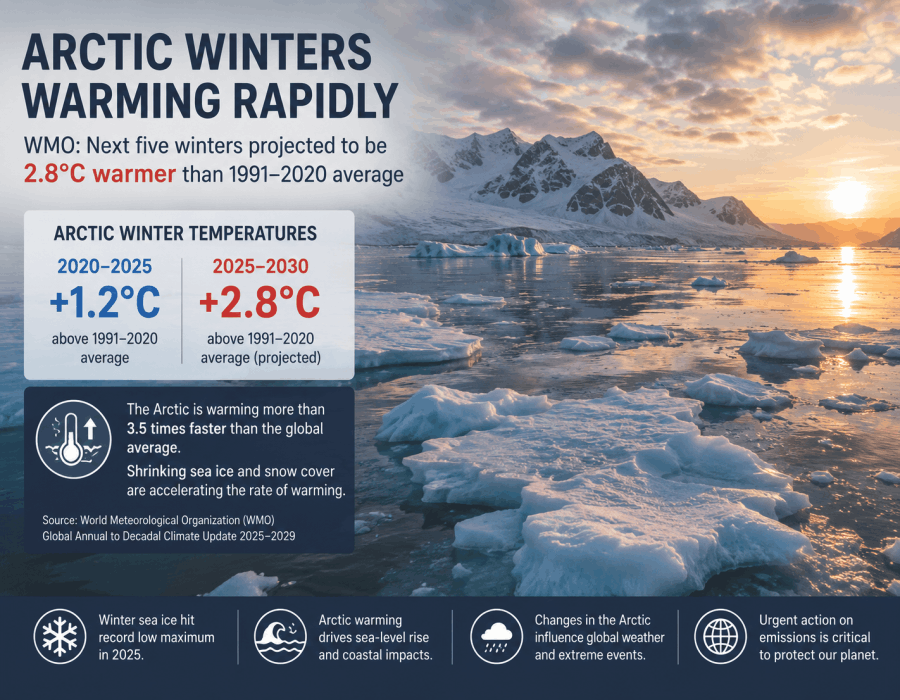 Scientists say the region, already warming faster than any other part of the planet, could experience average winter temperatures nearly 2.8 degrees Celsius above the 1991–2020 norm between now and 2030. That marks a sharp acceleration from the previous five-year period, when Arctic winters averaged about 1.2 degrees Celsius above the same baseline.
The projections come from the WMO’s latest Global Annual to Decadal Climate Update, which warns that Arctic warming is occurring more than three-and-a-half times faster than the global average.
“This is a region undergoing extraordinary change,” climate scientists involved in the report said, pointing to the loss of reflective sea ice and snow cover as a major driver of the rapid warming trend.
The Arctic acts as Earth’s natural cooling system, reflecting solar radiation back into space through its bright ice and snow surfaces.
As temperatures rise and ice melts, darker ocean water absorbs more heat, accelerating warming in what scientists describe as a dangerous feedback loop.
The consequences are already visible across the region.
According to the WMO and NOAA Arctic Report Card, Arctic surface temperatures from late 2024 through 2025 were the warmest recorded since modern observations began in 1900. Winter sea ice also reached its lowest annual maximum extent in the satellite era earlier this year.
The shrinking ice cover has implications far beyond the Arctic itself. Scientists warn that rapid polar warming can disrupt global weather patterns, intensify extreme weather events, and accelerate sea-level rise by destabilizing Greenland’s ice sheet.
The WMO forecasts also suggest wetter conditions in northern Europe, Alaska, and Siberia over the coming years, while parts of the Amazon could become significantly drier.
Globally, the outlook is equally troubling
The WMO says there is a high probability that at least one year before 2030 will surpass the current global heat record. There is also a strong likelihood that average global temperatures over the next five years will temporarily exceed the Paris Agreement’s critical 1.5-degree Celsius threshold above pre-industrial levels.
Climate experts say the Arctic’s rapid warming should serve as a warning to governments worldwide.
“The Arctic is effectively the planet’s early warning system,” researchers have repeatedly emphasized in recent climate assessments. “What happens there will not stay there.”
Scientists stress that cutting greenhouse gas emissions remains the only long-term solution to slowing the accelerating pace of warming. Without rapid reductions in fossil fuel use, they warn, the Arctic could face increasingly ice-free winters and irreversible ecosystem changes within decades.
Source: WMO
The tags below provide an opportunity to view previously posted related news within the selected category