
News
New Arctic Observing Summit Report Calls for Indigenous-Led Future in Arctic Science
A newly released report from the Arctic Observing Summit 2026 is calling for a fundamental shift in how Arctic research and monitoring are conducted, placing Indigenous leadership, community priorities, and societal benefits at the center of future observing systems.
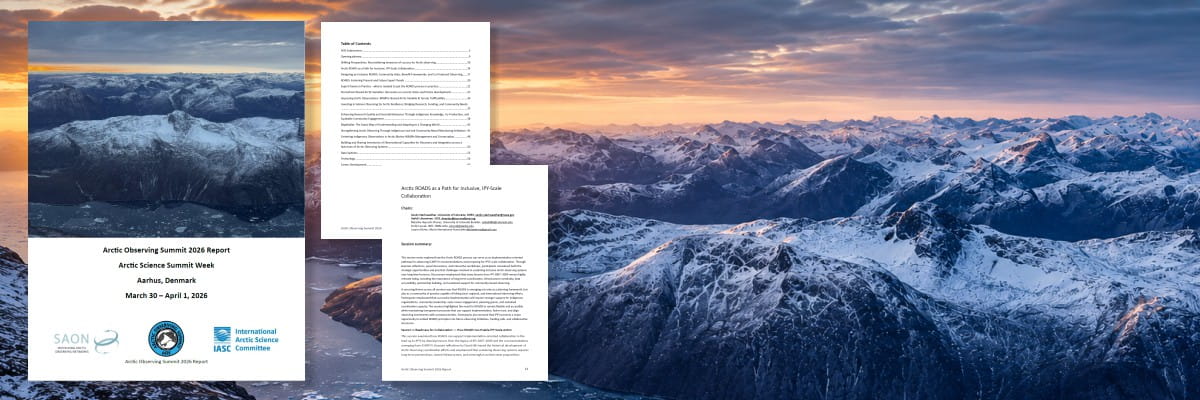
The report summarizes discussions and recommendations from the Arctic Observing Summit, held in Aarhus, Denmark, from March 30 to April 1, 2026, during Arctic Science Summit Week. The event was organized by Sustaining Arctic Observing Networks (SAON) and the International Arctic Science Committee (IASC), bringing together scientists, Indigenous leaders, policymakers, community representatives, and early-career researchers from across the circumpolar North. Together, they argue that Arctic observing systems must evolve beyond traditional scientific data collection to better support communities confronting rapid environmental and social change.
Throughout the summit, participants emphasized that Indigenous knowledge should be recognized as an equal and essential foundation for Arctic observation, research, and decision-making. The report highlights the need for stronger Indigenous governance, long-term community partnerships, equitable funding structures, and greater support for Indigenous-led monitoring initiatives.
The summit also highlighted growing momentum behind the Arctic Roadmap for Observing and Data Systems (ROADS), an international effort designed to coordinate Arctic observations across regions, disciplines, and knowledge systems. Organizers described the initiative as a key framework for preparing large-scale international collaboration ahead of the Fifth International Polar Year (IPY5).
Several sessions focused on Shared Arctic Variables (SAVs), a new approach that identifies observations most relevant to Arctic communities and decision-makers. Discussions ranged from permafrost monitoring and wildfire risk assessment to salmon population tracking and terrain trafficability.
Permafrost experts emphasized that future monitoring must integrate engineering, public health, Indigenous knowledge, and community concerns. Recommendations included expanding observation networks beyond existing pilot regions and ensuring local communities help determine which observations matter most.
Wildfire researchers showcased new machine-learning tools that combine satellite data with citizen observations to improve wildfire preparedness and land-use planning. Participants called for greater collaboration among projects using community-generated observations to strengthen Arctic monitoring networks.
One of the summit's most policy-relevant discussions centered on Chinook salmon declines in Alaska's Bristol Bay region. Experts called for increased investment in long-term monitoring, stronger inclusion of Indigenous knowledge holders, and greater attention to food security and community well-being alongside biological indicators.
Across multiple sessions, participants stressed that Arctic observing systems must be evaluated not only by scientific outputs but also by their contribution to local resilience, cultural continuity, public safety, and environmental stewardship.
The summit concluded with a series of recommendations directed at governments, research institutions, and funding agencies. Among them were calls for Indigenous data sovereignty, dedicated funding for community partnerships, expanded support for early-career researchers, and the development of more inclusive measures of success for Arctic observing programs.
Among the report's recommendations are calls for dedicated funding to support relationship-building with Indigenous communities, expanded community-based observing programs, improved monitoring of permafrost, wildfires, and fisheries, and new measures of success that reflect local well-being, cultural continuity, and resilience.
As Arctic temperatures continue to rise at nearly four times the global average, the report concludes that effective observing systems will depend not only on technological innovation but also on trust, collaboration, and the inclusion of the people who live in the Arctic every day.
Read the AOS Summit 2026 Report
Source: IASC
The tags below provide an opportunity to view previously posted related news within the selected category