
News
The Transarctic Transport Corridor as a Driver of Sustainable Development
During the International Arctic Scientific Forum, held in Norilsk on July 20, 2026, Ekaterina Serova, Director of the International Department at the Project Office for Arctic Development, presented an integrated vision for the development of Russia’s Arctic zone and the Transarctic Transport Corridor.
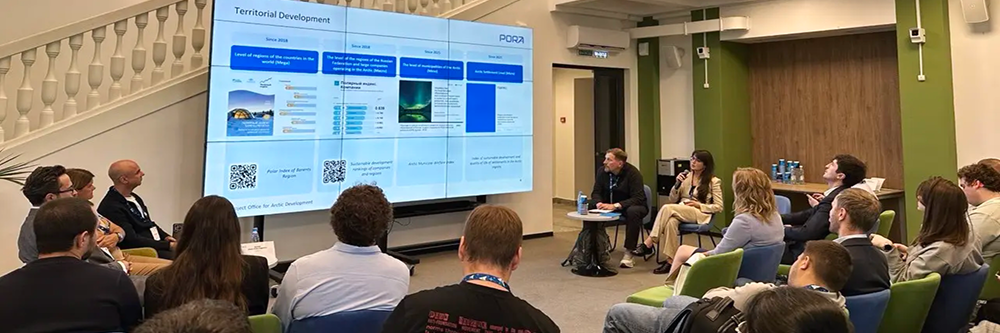
According to Serova, the development of the Russian Arctic and the corridor should be approached as a single strategic project linking the Northern Sea Route with inland waterways, Siberia, and the Russian Far East. The aim is to strengthen transport connections, support the economic development of northern regions, and increase the role of the Arctic in both national and international logistics.
The project, however, is not limited to ports, shipping routes, and transport infrastructure. Serova stressed that its development should also include energy and digital systems, more efficient logistics services, environmental protection, and measures supporting Arctic communities.
Particular attention was given to environmental challenges. The priorities outlined included restoring areas affected by industrial activity, reducing marine and river pollution, protecting biodiversity, and improving environmental monitoring. Adapting infrastructure and settlements to thawing permafrost was also identified as a major concern for the future of northern regions.
The Transarctic Transport Corridor is therefore presented not simply as a new commercial route, but as a broader strategic network connecting territories, infrastructure, and communities. In Serova’s view, the Arctic Ocean could become an important space for a new model of development based on international cooperation, territorial connectivity, and long-term sustainability.
Achieving this vision would require significant investment, long-term political commitment, and stable cooperation between governments, businesses, scientific institutions, and international organizations. Serova also emphasized that major transport corridors are shaped not only by market forces, but by long-term strategic planning.
The forum, organized by Polar State University together with Norilsk Nickel, brought together researchers, educators, students, and specialists, mainly from Russia and China. Discussions focused on permafrost, climate change, environmental protection, education in northern regions, and the future of international scientific cooperation in the Arctic.
Explore the Arctic Shipping Routes
The map below provides a broader geographical overview of the main Arctic sea routes and ports. It highlights the Northern Sea Route, the North-East and North-West Passages, and the potential future Trans-Arctic Shipping Route across the Central Arctic Ocean. The map also shows Russian delivery lines, sea-ice conditions, Exclusive Economic Zones and international waters, placing the proposed Transarctic Transport Corridor within the wider Arctic transport network.
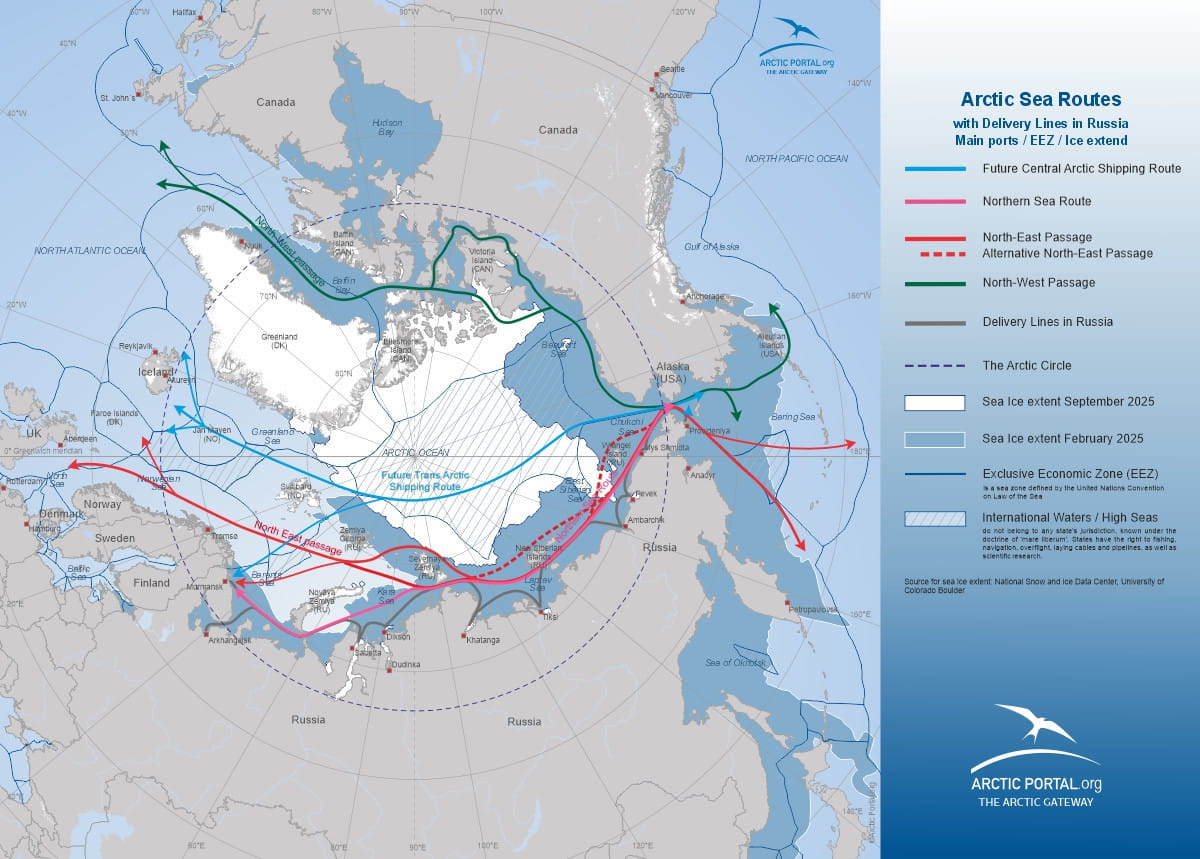
Arctic Sea Routes with main ports and EEZ - Northpolar Russia projection, Arctic Portal
View more of our maps in our Map Gallery
Source: PORA
The tags below provide an opportunity to view previously posted related news within the selected category